
For ALS patients, failing to access a cure, it is important to overcome certain important problems. Alas a chair that can be controlled by gaze, telemanipulation arms, intelligent ventilation, and a device for vocalizing by thought, will not be marketed for another decade or two.
The press echoed two recent articles about devices for vocalizing through thought. One acquires the data via a deep cranial implant, the other via a surface cranial implant.
 I analyze below the first article because the data and programs to implement this experiment are publicly available. Which is apparently not the case for the second.
I asked one of the authors if it was possible to use his program with an EEG helmet. We'll see what his answer will be, but I anticipate that the results of this course of action will be very disappointing.
The study focused on understanding how facial movement and speech production are organized in the motor cortex at the level of individual neurons. Neural activity was recorded from microelectrode arrays implanted in the brain of a participant with amyotrophic lateral sclerosis (ALS) who had limited facial movements and an ability to vocalize but not produce intelligible speech.
The results indicated neural solid agreement on various facial movements in a region of the brain called area 6v, and this activity was very distinct for different movements. In contrast, area 44, traditionally associated with speech production, appears (in this experiment) to contain little information about facial actions or speech.
The ventral premotor cortex, which is located in the middle of the upper part of the brain has been involved in motor vocabularies in both speech and manual gestures. A recent prospective fMRI study demonstrated adaptation effects in the ventral premotor cortex to repeating syllables.
Broca's area, is a region in the frontal lobe of the dominant hemisphere, usually the left, of the brain with functions linked to speech production.
The researchers developed a decoder using a recurrent neural network (RNN) to translate neural activity into speech. The participant attempted to speak sentences and the RNN decoded the predicted words in real-time, achieving a word error rate of 9.1% for a vocabulary of 50 words and 23.8% for a vocabulary of 125 000 words. This demonstrated the feasibility of decoding speech attempts using neural signals.
The neural representation of speech sounds in the brain was analyzed, showing that the activity patterns reflected the articulatory features of the phonemes. This suggests that even after years of paralysis, the detailed articulatory code of phonemes remains preserved in the brain.
The study also discussed design considerations for improving the accuracy of speech brain-computer interfaces (BCIs), including vocabulary size, number of electrodes used, and size of the training data set. The researchers noted that while their results were promising, there was still room for further optimization and improvements in the technology.
Overall, the study presented a proof of concept for a speech BCI that could potentially enable people with severe motor impairments to communicate more effectively by translating their intended speech into text from neural signals.
 For them, symptoms often start with weakness, unreliability, and thinning of the thumb or calf, and with time the disease progresses to other (skeletal) muscles.
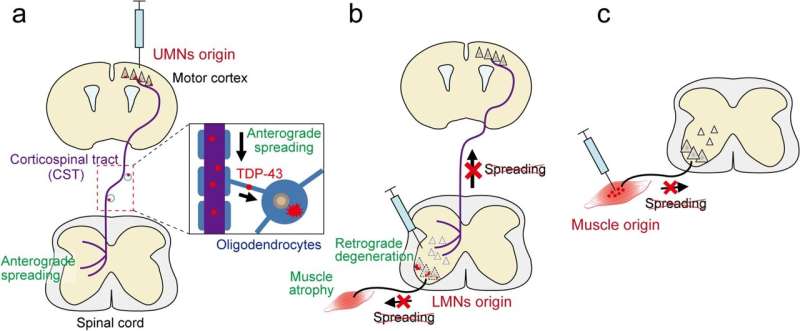 Les auteurs ont établi de nouveaux modèles de SLA de souris qui induisaient initialement des inclusions de TDP-43 mutant dans des types neuronaux ou cellulaires spécifiques dans les circuits moteurs, et ils ont étudié si le TDP-43 et les processus pathologiques pertinents se propageaient à travers les connexions neuronales ou cellulaires.
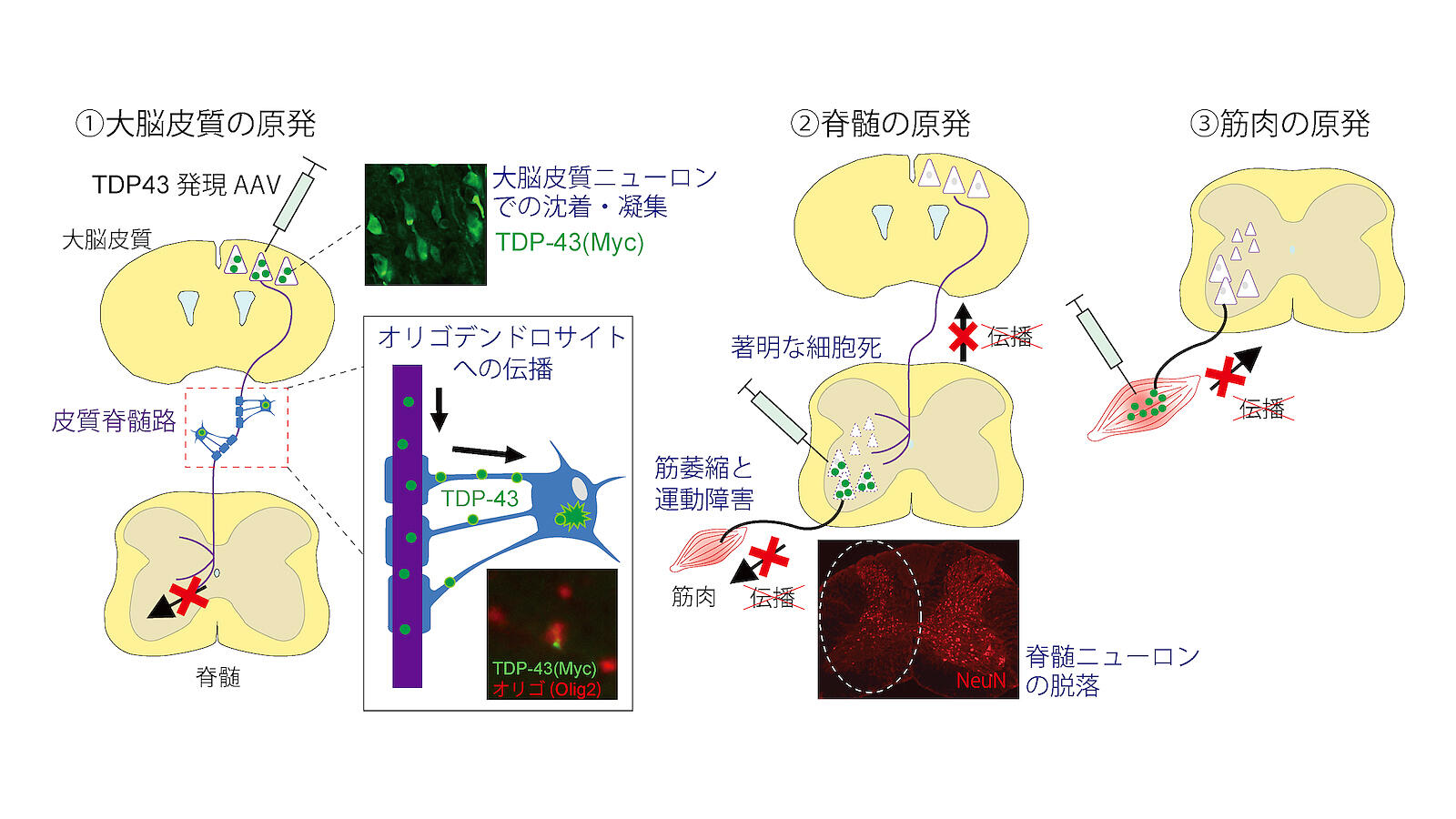 Tsuboguchi et al., Acta Neuropathologica 2023.
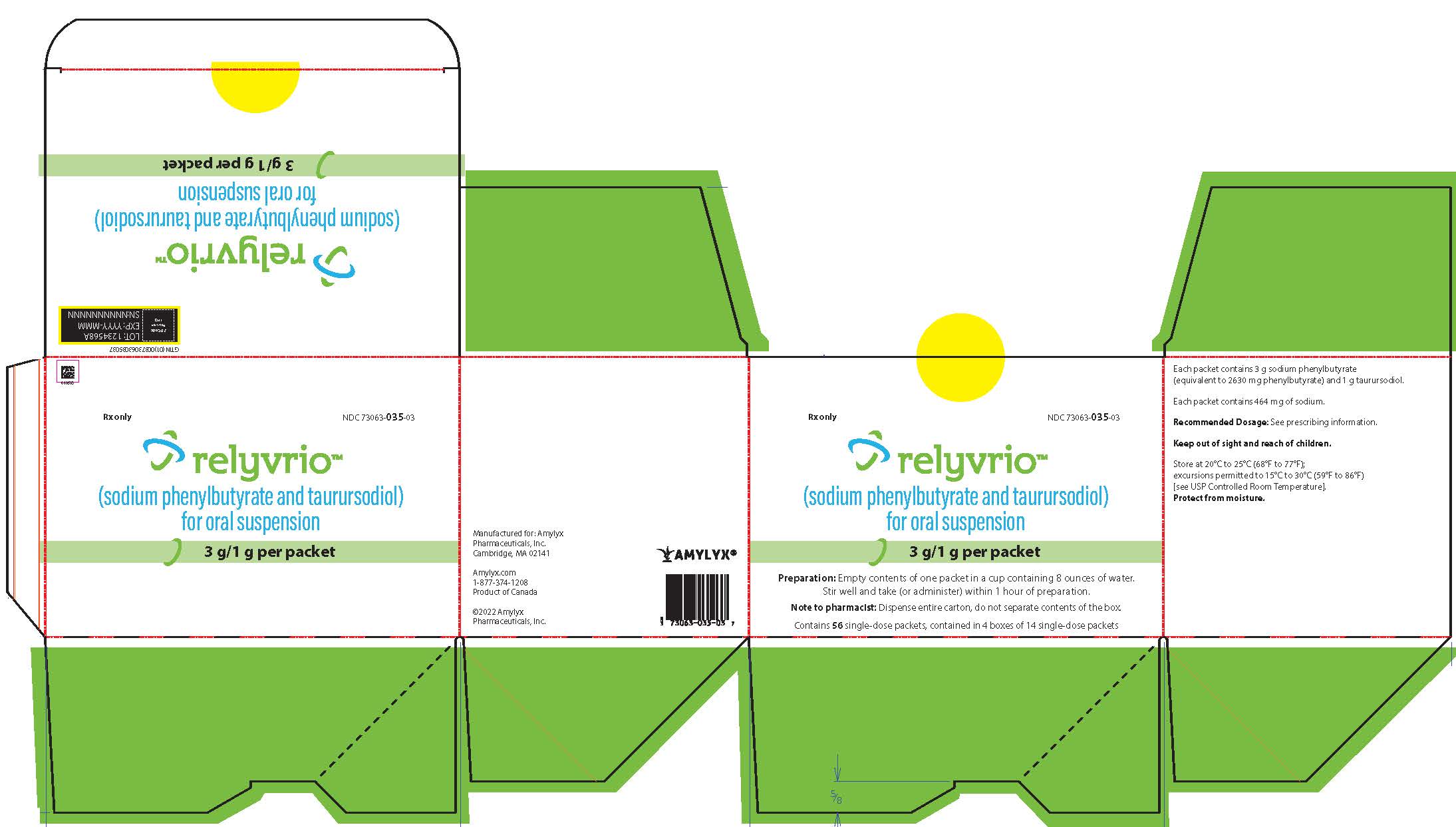 La FDA et l'agence Européenne des médicaments ont exprimés de nombreux doutes sur l'efficacité de ce médicament au cours de l'essai CENTAUR.
Ces doutes concernent l'exclusion d'un certain nombre d'évènements défavorables lors de l'analyse statistique, ainsi que le fait que certains patients ont aussi reçu du Riluzole et de l'Edaravone.
En particulier il y a plus de patients ayant reçu de l'Edaravone dans la branche contrôle que dans la branche traitement, or certains scientifiques et agences du médicament pensent que l'Edaravone a un effet négatif sur l'évolution de la maladie. Certains médecins ont également attribué les "bons" résultats au TUDCA.
Au final à 24 mois il n'y a pas d'amélioration de la survie.
La FDA et l'agence Européenne des médicaments ont exprimés de nombreux doutes sur l'efficacité de ce médicament au cours de l'essai CENTAUR.
Ces doutes concernent l'exclusion d'un certain nombre d'évènements défavorables lors de l'analyse statistique, ainsi que le fait que certains patients ont aussi reçu du Riluzole et de l'Edaravone.
En particulier il y a plus de patients ayant reçu de l'Edaravone dans la branche contrôle que dans la branche traitement, or certains scientifiques et agences du médicament pensent que l'Edaravone a un effet négatif sur l'évolution de la maladie. Certains médecins ont également attribué les "bons" résultats au TUDCA.
Au final à 24 mois il n'y a pas d'amélioration de la survie.
 In the case of ALS, the clusters of TDP-43 are also located in the cytosol, i.e. where the proteins are produced, before being folded up in the ER and then sent to their place of use by the Golgi apparatus. After shipment, TDP-43 should be in the nucleus.
 Des preuves cliniques et épidémiologiques établissent un lien entre les altérations métaboliques et l'apparition et la progression de la sclérose latérale amyotrophique. Ces défauts métaboliques précèdent les symptômes moteurs, ce qui suggére que ces défauts sont au moins en partie à l'origine de la SLA.
 Des scientifiques se sont demandé quel était l'impact de l'exposition aux stéroïdes endogènes et synthétiques chez les patientes atteinte de la SLA. Ils ont comparé cet impact à celui d'un groupe comparable mais ne souffrant pas de la SLA.
 The authors initially hypothesized that activation of the inhibitory co-receptor PD-1 by recombinant PD-L1 would be anti-inflammatory. However, recombinant PD-L1 ligand and recombinant PD-1 receptor were strongly pro-inflammatory.
Then they abandoned the PD-L1 strategy and chose a strategy with dimethyl fumarate (DMF), a drug approved against two autoimmune diseases, multiple sclerosis and psoriasis, and the cGAS- STING H-151 involved in autoimmunity.
The authors initially hypothesized that activation of the inhibitory co-receptor PD-1 by recombinant PD-L1 would be anti-inflammatory. However, recombinant PD-L1 ligand and recombinant PD-1 receptor were strongly pro-inflammatory.
Then they abandoned the PD-L1 strategy and chose a strategy with dimethyl fumarate (DMF), a drug approved against two autoimmune diseases, multiple sclerosis and psoriasis, and the cGAS- STING H-151 involved in autoimmunity.